Friday, October 19, 2012

Victoria's Secret Fantasy Bra 2012 Unveiled

by Fred Victor


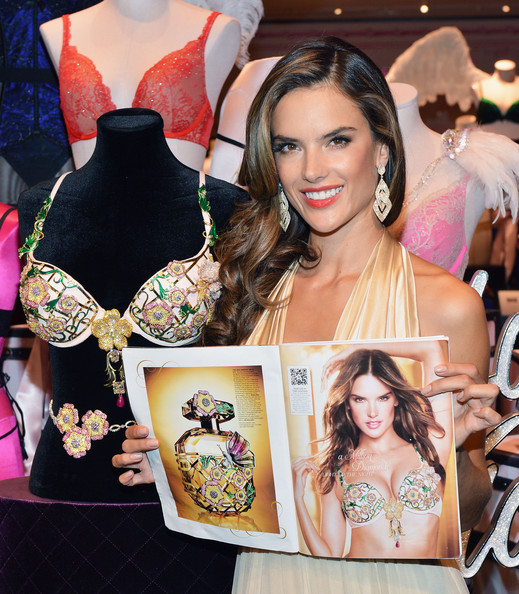
Alessandra Ambrosio, a Brazilian beauty, just wanted to scream when she was selected to model the Fantasy Bra at the Victoria's Secret Fashion Show. She was delighted to be chosen to wear the prestigious jewel-encrusted piece - which is redesigned every year - for the 2012 catwalk spectacular. She said: ''I just wanted to scream. But I won't lie, I was really worried.''


This year, the Fantasy Bra takes a floral theme and the $2.5 million (about RM7.6 million) design by Long Island's London Jewellers, design features a centrepiece of a 20 carat white diamond, couple with 5,200 other gems including amethysts, sapphires, rubies and diamonds set in 18-carat rose and yellow gold.

Look! This piece of art is hot, simply stunning!

The 2012 Victoria's Secret Fashion Show is set to take place on November 7, 2012 (airing on CBS in December) and will feature performances from some great artists like Justin Bieber, Rihanna and Bruno Mars. 

Previous VS angels to have donned the Fantasy Bra include the incredible Miranda Kerr, Gisele Bundchen and Heidi Klum. 


 [Video] Victoria's Secret's Floral Fantasy Bra: Behind the Scenes


Saturday, October 13, 2012

Creative Advertising - Billboard

by Fred Victor

A creative billboard, an outdoor advertising method, is one of effective ways of promoting your products to the massess. Here are some inspiring and creative billboard designs. 

In brief, outdoor advertising is a distinct medium, and creative message should be specifically geared to. Your billboard message is extremely important to the overall success of your campaign. Of course, lengthy message is prohibited as passers-by will not be able to read. Images for your billboard use should be very carefully selected. After all, this image could end up being over 48 feet wide! Defects in the image will be magnified at this large size. The resolution of image is extreme important.


Monday, October 1, 2012

The Importance of Product Life Cycle in Media Planning

by Fred Victor


A company’s product life cycle (PLC) has a significant impact on decisions making when it comes to media planning as managers will make different marketing decisions at each stage in a product's life, for instance, from the beginning with the need to generate awareness for a new product, then ending with the ability to maintain that awareness.

Incorporating PLC in media planning is an essential task that must be continually undertaken. The competitive business environment is undeniable, like shifting market conditions, including the ever-changing customer needs and wants, almost always ensure that what worked in the past will not work in the future, hence requiring media planning revisions in how a product is marketed.

New Product Entry Points
When a new product is introduced, the challenge will be the effort to generate awareness for that product. At this very early stage of market introduction, the use of traditional print and broadcast media is a proven way to create awareness and ultimately demand.

Establishing the Preference
As soon as a product has public awareness, marketers begin creating product preferences among target customers. Establishing that preference over other available offerings requires telling the product's story through selected media channels. For instance, mass media can be considered including social media as it allows more information to be shared virally.

Competing in a Crowd
Often, this occurs during a product's mid-life stage where marketers begin to rely on word-of-mouth (WOM) generated through satisfied customers as well as the third-party endorsements such as celebrity endorsements.

Maintaining the Awareness
Once a product is established e.g. Secret Recipe, AirAsia etc., the advertiser's challenge is to maintain that public awareness. At this stage, mass media platform becomes important in maintaining a general level of awareness for a product where it also raises awareness among new market entrants.

Starting Over
A product or service will eventually reach a point of diminishing returns; media use declines when this happens, provided the marketers are able to introduce a brand extension or a completely new product. Of course, the life cycle starts all over again.

In other words, at every stage in a product's or service’s life cycle, marketers will critically consider the choices related to generating public awareness, customer preference, demand, and ultimately the purchase decisions. 

Sunday, November 6, 2011

Advertisement is an Investment, Not Expenditure – Marketing Channel


by Fred Victor

Well, it’s a million dollar question particularly for those conservative-cum-old fashion business owners or managers. Often, advertisement is considered as expenditure. Some broiling questions like “How much we need to spend”, “Can we spend less than 3% based on total projected sales?” and other concerning matters that have put them in advertising dilemma.

In todays’ heavily brand-driven business environment, advertising budget should be considered as part of a brand investment rather than considering it as expenditure. In fact, such investment helps developing and strengthening your brand in short- and long-term, if it’s advertised (or invested) effectively.

So, isn’t it “unfortunate” to consider advertising as expenditure, but not investment? Let’s dissect the issue a bit further.

First, should advertising investment be considered as advertising expenditure/cost (like any other costs, fixed or variables) is to be passed on to the consumer? Or, should advertisement be considered as an investment by your company (for a brand) which helps increasing your brand strengths, sales and market share eventually, resulting in economies of scale which either reduces the overall cost of investment or increases the brand values to your customers, partners, shareholders and employees.

An unfortunate Pricing Example:
Product cost = Cost of Goods Sold + Direct/Indirect Costs + Manufacturing Costs + Advertising Costs

Frankly, it’s weird that advertising cost is taken into account in determining a product’s price. As a general rule of thumb, pricing methodology covers both direct/indirect cost and manufacturing costs. Advertising investment should not be included as the “returns” – brand contributions (ensued from advertisement) are expected to provide surplus (or incremental sales) towards covering direct/indirect costs.

Having said that, advertising investment is not a cost in the same manner as fixed or variable costs or any other attributable overheads, but measured as a long-term investment in your brand on which the brand must generate “returns”.

In sum, “returns” should be a matter to deal with when it comes to investment in advertisements. It’s all about the potential returns from the (advertisement) investment, where (a) brands strengths (ensued from brand exposure), (b) sales (ensued from product/brand exposure), and (c) market share (ensued from product exposure) are factors that to be achieved.

As far as advertisement is concerned, expenditure ... is irrelevant!

Saturday, October 15, 2011

Corporate (Business) Strategy Examples


by Fred Victor

In general, every organization will establish its own set of business strategies in order to support the missions and vision, and ultimately achieve goals. In other words, leaders who take the initiative to analyze and understand their market, industry and other external factors can actually develop strategies that are most likely successful.

As a matter of business strategies, there are various types in order to outplay the competition and ultimately generate business “growth”. To achieve both, your business must find, evaluate and select a strategy to capture a potential market.

Two classical examples are illustrated here. More importantly, there are attractive strategies available to small and medium businesses to compete against the scale economies that larger competitors are able to achieve.

Luxury Brand-focused: LEXUS
Some companies choose to position their products (or services) at the high end of the overall competitive pricing scale. Brand like LEXUS is best to illustrate this!

Luxury brands appeal to a distinct group of consumers with ample disposable income and the desire to purchase exclusive products. Companies that choose this strategy are able to increase their ROI (Return on Investment) through product cost versus volume. The customers may be fewer, but they will buy more expensively.

Back in 1957, when TOYOTA entered the American market, they were not considered a threat at all to the American auto industry. It was believed that TOYOTA cars had no appeal to American consumers. But, in the 1970s, there were problems such as the 1973 Oil Embargo, environmental regulations, and quality control issues with some American cars. In response to these “opportunities” (when most people considered it as “crises”), TOYOTA aggressively marketed their cars to Americans as being fuel-efficient, environmentally friendly, and having better build quality than the American cars.

What’s more, TOYOTA marketed their cars as being hip and fun with memorable and fun-filled slogans like, “you asked for it, you got it, Toyota,” and with commercials involving young TOYOTA drivers jumping in the air. As a result, TOYOTA’s marketing campaign along with continuing problems from the Big Three auto manufacturers, allowed import cars to make up about 20%of the American car market by 1980.

After successfully gaining a sizable market share in the American market, TOYOTA decided to create the LEXUS brand in 1989. LEXUS is crafted to target the luxury car market segment which was dominated by Mercedes-Benz and BMW … at that time.

They decided to create a new brand because of their brand image portrayed as only offered fun and fuel-efficient compact cars. As a matter of brand differentiation strategy, the introduction of luxury models into TOYOTA existing lineup would dilute the TOYOTA brand.

Hence, TOYOTA marketing strategy was to position LEXUS as a separate company with almost no references to TOYOTA. Heavy emphases towards quality customer service and a separate dealership network from TOYOTA were implemented. Such business/marketing strategy has allowed LEXUS to outplay its competitors like BUICK, MERCURY and LINCOLN, and become one of the best-selling luxury cars in the US by 2000!

Niche Market-focused: PEPSI

Most often, when a market, business or other external factors forces a business to make important decisions about future direction of their operation vis-à-vis the rest of business initiatives and directions, niche markets are particularly interesting for business looking to grow and/or to change, perhaps.

Niche markets consist of groups of consumers (often considered as market segments) within a larger marketplace who have similar demographic, buying behavior and/or lifestyle characteristics.

Therefore, a niche-focused business strategy targets a narrow group of consumers with a product and/or service designed specifically to meet their needs and wants.

The cola wars between PEPSI and COKE began in the late 1930s when PEPSI started making gains in the market. PEPSI realized that African Americans were an untapped niche market at the time, and that PEPSI stood to gain market share by targeting its advertising directly towards them.

In 1940, PEPSI CEO Walter Mack had the unprecedented idea of putting together a "negro-markets" department. Edward Boyd led the team of 12 black professionals, making Boyd one of the first black executives in corporate America. He and his group developed a marketing strategy seeking brand loyalty among African Americans.

The strategy was one of the first attempts at niche marketing, and it worked!

PEPSI sales in targeted communities shot up over one concerted two-week campaign by 13%.

What’s more, PEPSI was a sponsor of the exhibition, its early efforts at workforce integration and racial harmony are clearly good public relations almost six decades later.

Thursday, October 13, 2011

Fashion Show Theme Samples


by Fred Victor

In my opinion, fashion shows are cool by nature. There are many elements needed in order to vow the audience (but not to overwhelm them). Among the many elements, the “theme” and its scripts are hyper important. They actually play as the introduction before the showing, scripts are therefore further telling in-depth stories and/or ideas about the showing.


I’ve recently authored some interesting themes (I believe), and was recently shown at Tropicana City Mall, Malaysia.

Here you go:-


Summer Beach Party

“The bed sheet you wear tells quite a story, 
Probably it’s self-esteem with glory, 
Whether it’s a blaze of glory or story, 
Let’s find a story in this summer beach party …”


Fansy World

“Sleeping in a world of fantasy, 
It’s something everyone wants to be, 
If you wanted it desperately, 
Let’s chase a dream in this world of fansy …”


Princess Party

“Are you the pretty princess of party, 
As tasty as a strawberry, 
Loves party music like Katy Perry, 
Oh pretty, let’s get to the princess party …”


Glimmer & Glamour

“Like jewelries that twinkle, 
As glamour as a luxury label, 
It’s a sense of comfort that most lovable, 
A décor with glimmer and glamour, simply incredible …”


Golden Egyptian

“The royal and luxury is always fine, 
Egyptian pyramids were once upon the time, 
If you need a bed sheet to appear in lines, 
A fabric dressed Golden Egyptian is right on the line …”


Beautiful Night

“Is tonight gonna be a good night? 
Need a wonderful and restful night, 
Asked if which bed sheet will treat me right? 
And I’d say “darling, I just want a beautiful night …”

Saturday, October 1, 2011

Fashion Show Planning Guide

by Fred Victor

Well, fashion shows are fun, and great ways to introduce a fashion line and/or fashion store/boutique to the public or the fashion community.

Although organizing a fashion show can be extremely time-consuming as it requires hard teamwork involved, it will pay off in the end.  

Besides, highlighting the problems within the community or industry is another extreme valuable thing to deal with. You may consider addressing issues on global warming, healthy living, recycling, child abuse and other issues. Having said that, it’s not a one-man-show task, but a team!

Therefore, planning a fashion show requires lots of attention and detailed-understanding throughout the show. The following tips may provide a guidance to plan and implement a successful show.

So, let’s get down to the business!

1. Make an ideal budget, sponsorships are always considerable.

2. Venue for the show is important as it dictates the date and length of your show. Consider whether it will be possible for you to hold rehearsals.

3. Recruit your team such as show producer, backstage manager, entertainment manager, stylist / wardrobe manager, hair & makeup artist, casting manager, program and guest list manager, promotional manager (see note below for their basic job description respectively).

4. Pick a theme. A fashion show themed as “eco fashion” doesn’t mean it has to follow a particular format. Just be as creative as you like. Enjoy it and have fun!

5. Decide the length and layout of the catwalk.

6. Be creative! You can consider having dance routines, live music or magic show to be part of your show.

7. Think about how you are going to introduce your show.

8. Investigate need for special permits, licenses, insurance etc.

9. Pick a good photographer.

10. Make sure the show starts within 15 minutes of the scheduled time, it’s respectful of the guests.

11. Understand the taste of journalists, editors and media partners that you invited.

12. Be creative on your script with great emcee. Audience will certainly be attracted.

13. Have some sort of fun-filled description of any add-on accessories for the emcee to speak about, this adds sense of humour and helps guests to remember certain fashion line after seeing them only for 30-plus seconds each.

14. Don’t forget to bring enough body makeup for any unexpected suntan lines of body blemishes on your models.

15. Have great dressers who can quickly assist your models to dress, especially the model that will be shown a lot.

16. Don’t forget the double tape (for you to mark out the shape and length of the catwalk).

17. Arrange for photos of VIPs, celebrities, committees, models etc.

18. Don’t blow out guests’ eardrums! Play congruent music for each mood set, make sure it has a good beat that doesn’t urge he models to walk too fast). Transition music is important too.

19. Meet and greet with the designers after the show for media.

20. Don’t forget to recognize the sponsors (you should find sponsors to collaborate if you’re new).

21. Simulcasts your show on large screens to the right and/or left of the stage. Webcast it, and send out bulk e-mail targeting buyers who may not be able to attend the show.

22. Last but not least, REHEARSE, REHEARSE, and REHEARSE!!


NOTE TO YOUR TEAM
Show Producer ensures that everyone else knows what they are doing and are doing it.
Backstage Manager ensures that everything goes exactly to plan on the day.
Entertainment Manager informs the other performers about rehearsal times and dates.
Stylist/wardrobe Manager is responsible for the content of the show.
Hair and Make-up Artist creates image for the models.
Casting Manager makes certain that all models know what they are doing.
Program and Guest list Manager designs the show program and compiles as well as manage guest list.
Promotional Manager advertises the event.

Saturday, September 24, 2011

Keywords as Marketable Branding Tools

by Fred Victor

It’s really a question when this is brought to the table, many of us could have possibly ignored it, perhaps. In brief, when writing Website content, blog post or product/service description on a leaflet, by including powerful keywords that your target market uses to find you is undeniably important when it comes to search engine optimization (SEO).

Wonder if you have ever thought of any unique keywords to best describe your business, vis-à-vis the rest of your products and services? Needless to say, one of your business goals is to stand out, and to have your customers and new customers find you with those relevant keywords before they have the chance to think of alternatives, right?

Probably it’s time for you to start considering of any unique keywords to best describe your business, your brands, and your products/services.

To begin, here’s some tips to conduct keyword research which in a way to ensure your business becomes synonymous with those keywords.

Define Your Keywords
Always be remembered that to avoid using hyper-competitive keywords that will easily pull up millions of hits e.g. fashion. Having said that, you should narrow down the list of possible keywords by adding 2 to 3 words e.g. Fashion Online Malaysia.

Conduct Keyword Search
There are several online tools available that you can easily use to conduct keywords search.  Let’s start with some popular platforms like Wordtracker, Market Samurai, or Google Webmaster Tools.  Once determined, you should inform your marketing team to consistently use them, online and offline.

Linking Keywords Consistently
Once every keyword is defined, you should not ignore including relevant keyword into your each online post or printed material such as brochure. Just include those relevant keywords into your brand’s slogan, Facebook, Twitter, catalogue and so on. Last but not least, make sure your colleagues are using those keywords in ALL their communications with customers!

Again, it’s all about consistency ;-)

Friday, September 16, 2011

Three Common Social Media Marketing Strategy Mistakes Should Avoid

By Fred Victor

The social media marketing, often shortened as SMM, is definitely a modern marketing strategy nowadays which helps companies (especially the small businesses) building a network of customers, allowing customers to stay in touch with their preferred brands and/or products and/or services, and eventually building the customer loyalty and the bottom line in the form of sales through effective brand exposure, communication and values.

Discount-driven is no longer appropriate in today’s business context, but market-oriented will outperform in the competition.

Unfortunately, there are many businesses simply have no idea to build a sound social media strategy, and plenty of mistakes are made. Here’s some common mistakes should avoid.

1. Avoid “People have, I have” Mentality
Creating a social media network on e.g. Facebook is relatively easy; however, building such network isn’t as easy as it sounds. Too often, there are significant number of businesses are of the mind that “people have, I have”, and “once account created, people will join”.

Quality content in your social media updates and/or posts (on an ideal frequency) plays an important role that will be able to influence customers to like you, stay with you, remember you (if you’re unique enough), and ultimately purchase.

2. Avoid Too Many “Updates” and “Discounts”
Needless to say when you were bombarded with too many updates and/or posts relating to product photos and discounts. Accordingly, more than three posts a day considered too many (provided if you’re running a press agency). It’s also annoying when there are too many updates on a single product (with non-stop discounts offering). I’d certainly doubt over the quality of such product especially when it comes to high discount, wouldn’t you?

3. Avoid “No Interaction”
One of the reasons why fast-growing usage of social media around the world is simply because people like interacting with friends and others in real time. That’s what makes online games to become so widely played among friends and neighbours, around the world!

So, don’t ever fail to lure conversations with your fans or followers by posting quality contents on an ideal frequency. Don’t overdo!

The social media marketing “pie” (industry) is evolving rapidly. It’s definitely an opportunity for small businesses to further enhance their brands’ positions (e.g. niche) in order to compete with big brands.  

It’s definitely a place where “small knife cuts big tree” (小刀鋸大樹a well-known Chinese wisdom of life) scene could occur.

Nothing is impossible, it can be a miracle ;-)

Friday, September 2, 2011

How to Tackle Cannibalization - Marketing Channel

by Fred Victor

Not surprisingly, I was asked recently on the issue of cannibalization, where a company faces the dilemma of promoting a similar product range (under different branding strategy, perhaps) within the same retail environment.


Accordingly, one brand outclasses another. How?

I wrote this to reply:

Dear Madam,

I’m just pragmatic enough to share more ideas on the issue discussed via our tele-con last Saturday. Further to my very-short explanation on cannibalize as “cut-throat” (“yoi” in Cantonese), here’s a slightly long story to begin with.

It’s in fact a marketing strategy, cannibalization occurs when decreased demand on an existing product due to the “same” vendor releases another new “similar” product.

It sounds negative but can be extremely effective if it’s planned accordingly (to target customer) and stealing (expanding) market share quietly.

Let’s think outside the box, it’s all about our brand/product portfolio strategy!

Allow me to recap – cannibalization is an important issue in marketing strategy when a company aims to carry out brand/product extension (for itself and others).

Let’s take a real life example, when Philip Morris introduced Marlboro Light, a sub-category and similar product (to Marlboro Classic); such extended brand/product portfolio strategy is to “capture” a “broader” market segment (for those who love light smoking, for ladies, for new smoker etc.) although losing “some” sales in an existing segment (from Marlboro Classic). Marlboro stole market shares from Salem … quietly.

Accordingly, in effect, Marlboro Classic and Marlboro Light aren’t really competing for the same customer segment. Price is same, but taste lighter and smoother, packaging differs, marketing elements vary etc.

As per your case, is your “brand A” direct competing with your “brand B”? Should re-consider?

In my 2-cent opinion, to tackle cannibalization, brand/product differentiation strategy should exist – you should really differentiate both brand A and brand B. In short, the brand A should maintain its “major” entity, brand B should re-define its niche … quickly.

Have fun ;-)

Cheers,
Fred

Saturday, March 12, 2011

Victoria’s Secret “Angel Wings”: Strategic Marketing Synergy


by Fred Victor

The brand – Victoria’s Secret … it’s just phenomenal, and globally recognized! Why? Let’s get down to the business!

In their first decade of existence, the Victoria's Secret Angels have held the gaze of many men while successfully promoting the brand's best-selling lingerie lines to its intended female demographic. Amazing!

It’s all about the right combinations of synergies through strategic marketing channels. Let’s dissect the activities implemented by Victoria’s Secret …

The Originality
The Victoria's Secret fashion shows are globally known as their originality, excitement, sexy, and stunning characteristics which have gained them a global arena when it comes to lingerie designs.

Victoria’s Secret Angels
The “runway angels” are named, and actually referred as “fashion show models”. First-class supermodels (e.g. Helena Christensen, Claudia Schiffer, Tyra Banks etc.) had been hired for fashion shows, advertising campaigns etc. while taking on additional roles as Victoria’s Secret spokeswomen.

Their line-up has been changed several times over the years, and the brand currently lists 13 supermodels on its website, including Heidi Klum and Marisa Miller. Among other recognitions, the Victoria's Secret Angels were chosen to be part of People Magazine's annual "100 Most Beautiful People in the World" issue in 2007.


Currently, Victoria’s Secret angels include sexy supermodels like Adriana Lima, Alessandra Ambrosio, Miranda Kerr etc.

The Black Eye Peas
Needless to say, when Victoria Secret’s fashion shows met the men of Black Eye Peas and Miss Divalicious Fergie in 2009 & 2010, the heartbeat was simply “boom boom pow”!


Fashion Show
The Victoria's Secret fashion shows feature amazing fashion pieces accessorized with the all so renowned angel wings which Victoria's Secret has planned to use in its marketing strategy on Facebook.

Facebook Marketing
Victoria's Secret wings marketing strategy on Facebook will enable VS to promote even further the Angel wings featured on the catwalks, which have become emblematic for the Victoria's Secret brand.

The Angel wings have been worn by so many celebrity models such as angels Heidi Klum, Miranda Kerr, Adriana Lima and many more others, and now the wings will be displayed so everyone can admire them and more; take pictures with them.

Angel Wings Box
It seems that Victoria's Secret wings marketing strategy on Facebook enables women to take pictures with 9 vintage Angel Wings displayed near the brand's Soho store on Broadway. The wings were displayed in a manner to allow women to take a picture with them and the pictures were uploaded on the Victoria's Secret Facebook page, in a section of the album called “WINGS! NYC”.


The photos taken with the Angel wings were submitted in two ways: via MMS (multimedia text message from your phone) to the number 26435 (Angel) or via e-mail to an email address yet to be revealed.

The photos have been uploaded on the Victoria's Secret Facebook page after being reviewed and approved first, after which people will be able to search their photo and tag themselves so friends will be able to see the lovely Angel winged picture showed on the Facebook wall and download it.

It seems that Victoria's Secret currently has more than 11.7 million fans on Facebook and this will probably help them generating even more fans, circulations, readerships, and sales ultimately!

Summary
The Victoria's Secret Angels are a key ingredient in the company's phenomenon. The annual fashion show is a major event that shows off the hottest new lingerie on the hottest bodies on earth. It makes women want to wear the lingerie and men crush even more on the already stunning Victoria's Secret Angels.

Women might be the main consumer target for Victoria's Secret, they need to feel sexy at the thought of owning the product; men can still enjoy learning more about their favorite and beauty of sexy.

Friday, February 18, 2011

VW Ad Hits at Super Bowl

by Fred Victor


When the Pittsburgh Steelers and Green Bay Packers clashed at Super Bowl XLV in the United States recently, it wasn’t the final score of this American big show that sent the Internet. Oops, it wasn’t the tumbling singing sensation Christina Aguilera’s National Anthem too;

It was the VW’s clever commercial ad that stole the show!

In brief,  the ad featured Volkswagen’s (VW) The Force, which featured a child in a Darth Vader suit using mystical powers (or The Force, made famous in the Star Wars films), to move the home’s washing machine, family dog, a doll and his breakfast – albeit in vain.

Feeling dejected, the tiny “dark lord” than decides to use The Force on his father’s parked VW Passat 2012 in the driveway – and actually starts it, much to his surprise.

The humorous appeal started here when the car is actually started from a distance by his father via the vehicle’s “remote control start button” featured by VW!

The Super Bowl has been known to be a great platform to boost ads, and it’s not difficult to see why. The event is the most-viewed programme in the United States, and this year’s game attracted a record 111 million viewers.

The ad, which gave viewers a glimpse at Apple’s vision for its then upcoming Macintosh computer, has been widely regarded as one of the most memorable and successful American television commercials ever, as it was considered an important symbol of fighting conformity (considered to be IBM at the time).

At that time, Apple saw a 30% increase in the number of people going directly to their job search site!

“This year’s Super Bowl delivered an incredible audience count of 111 million. As an addition, the online audience reached nearly 30 million, we would probably look at figures that most advertisers would die for, and that’s without even considering the buzz and word of mouth interest this ad has generated.

When you look at these numbers, the US$3mil price tag starts to look reasonable for you. Sounds good deal huh? If you consider what it would have taken to reach that audience without the unique opportunity presented by the Super Bowl, you could even call it a bargain.


When you look at these numbers, the US$3mil price tag starts to look reasonable for you. Sounds good deal huh? If you consider what it would have taken to reach that audience without the unique opportunity presented by the Super Bowl, you could even call it a bargain

It is pretty interesting to learn that VW would have spent a bomb on the commercial at a cost of US$100,000 per second (for a typical Super Bowl ad), and the 30-second spot would have cost the German car manufacturer US$3mil just to air it.

In return, however, this commercial ad leveraged off the unforgettable Star Wars score and humour to create an emotional appeal and achieved more than 20 million hits on Youtube in less than a week.

Let’s take a shot!